What you are looking for
Look for a compact manufacturing mark that is separate from volume, product references, and retail barcode digits. It may be printed, stamped, impressed into a surface, or etched. There is no universal length: our supported formats include three-character and longer codes. Use the brand guide to check which subset the tool accepts.
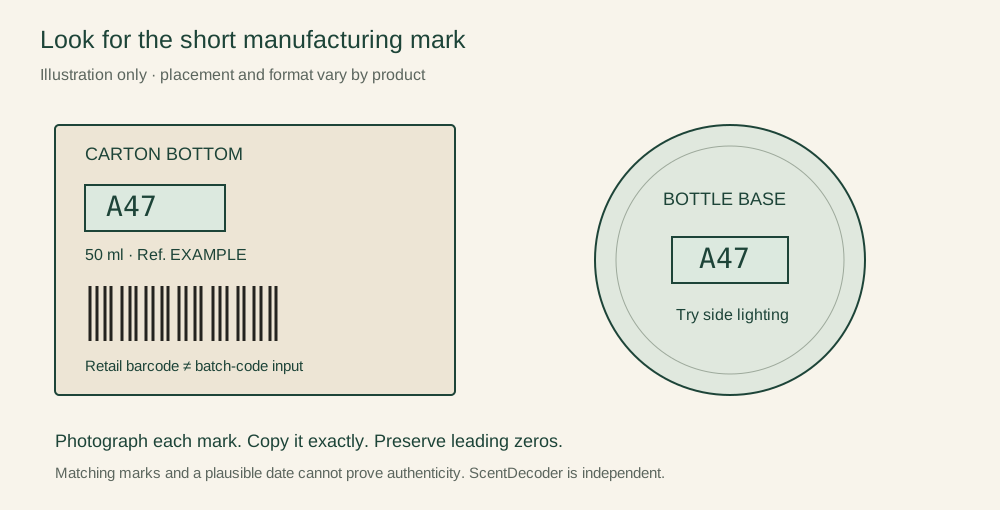
Check the outer carton first
- Turn the carton over and examine its bottom and lower panels in indirect light.
- Identify the manufacturing-style mark separately from the barcode, Ref number, ingredients, recycling symbols, and ml/oz declaration.
- Photograph the full panel and a close-up. Preserve leading zeros and record where the mark appears.
If the mark is not there, inspect other panels and carton flaps. Location is a search aid, not proof that an identifier is a batch code. The batch code versus barcode guide explains common lookalikes.
Then check the bottle base
Tilt the bottle under side lighting; direct flash may obscure a faint mark. A plain background behind clear glass can improve contrast. Photograph the complete base before zooming in. Check other visible labels if necessary, but do not remove seals or dismantle the bottle.
Do not scrub faint ink, scrape the glass, or apply solvent. For Jo Malone or Tom Ford, the current supported pattern is exactly three characters. That is a tool limitation, not a claim that every product from those brands uses that pattern.
Keep bottle and box observations separate
Transcribe each mark independently. If they differ, preserve both photographs and ask the seller about the box’s history. Do not edit one code to force a match. A physical code mismatch is a different issue from two tools giving different dates for the same input; neither issue alone establishes that a bottle is counterfeit.
Use the secondhand checklist to organize the listing and purchase record. Read what a code cannot prove before drawing an authenticity conclusion.
Avoid common reading mistakes
- Compare 0/O, 1/I/l, 5/S, and 8/B against the original image.
- Keep leading zeros. Do not insert punctuation or concatenate unrelated marks.
- Do not enter a barcode, Ref/SKU, PAO symbol such as 24M, volume, or address code.
- If a character is genuinely unreadable, note the uncertainty rather than trying random strings.
After you have the code
Select the correct brand, enter the mark, and save the result with its confidence label and check date. For Chanel and Dior, consult the supported-format examples before assuming a code is recognized. If it remains Unknown, retain that result and your photographs.
Found the code? Estimate its production date with ScentDecoder →
Frequently asked questions
Where is the batch code on most perfume bottles?
Start with the carton bottom and bottle base. Look for a compact manufacturing mark separate from the retail barcode. Placement and length vary, so consult the relevant brand guide.
Do different bottle and box codes mean fake perfume?
A mismatch alone cannot establish authenticity. Photograph both marks, check that they are the same type of identifier, and ask about the packaging history.
What if the batch code has rubbed off?
Try side lighting and a close-up photograph without scrubbing the mark. If characters remain unreadable, retain the uncertainty and contact the brand rather than inventing a code.
Is a batch code the same as an EAN or UPC barcode?
No. A conventional EAN/UPC identifies a product. A batch mark identifies a manufacturing lot. Some newer barcode formats can carry lot data too, but this checker expects the separate manufacturing characters.